
 Events & Tickets

Kunsthalle Würth
October 16, 2026 to October 3, 2027
Daily: 10 a.m. to 6 p.m, free admission
Anselm Kiefer (born in 1945 in Donaueschingen, Ger many) ranks among the world’s most renowned con temporary artists. More than 70 of his works from all phases of his career and across all the media he used have found their way into the Würth Collection. They are complemented by several additional works from Kiefer’s studio, including a collection of photographs whose postprocessing shifts the factual nature of the visible world into the entranced, rarefied realm of the painterly, where truth itself appears as a hypothesis.
Thus, the exhibition spans from the Occupations and Heroic Symbols of the 1960s and 1970s to Robert Fludd's natural philosophical reflections on the rela tionship between the microcosm and the macrocosm, and from the field and sea battle fantasies of Velimir Khlebnikov and the Heavenly Palaces of the Jewish Kabbalah to the enigmatic Women of Antiquity, scarcely remembered beyond their names. Finally, the leaden libraries come into view – and with them books and writing, in objects and images, as references to stored knowledge, history and literature. Kiefer also turns his attention to Madame de Staël’s (overly) idealized view of German poets and thinkers 6 of a sometimes dark Romanticism, as well as to the traumas that shaped the work of poet the Paul Celan. His poetry, which Kiefer deeply admired, powerfully and profoundly refuted Adorno’s assertion that it would be impossible to write poetry after Auschwitz without aestheticizing the horror. Mao’s poisoned slogan, “Let a hundred flowers bloom,” also finds a response in Kiefer’s work. “In my paintings,” says the artist, “I tell stories to show what lies behind history. I dig a hole and crawl through.” His battered works – exposed to ash, fire, storm, and rain – become stages for these exca vations. The supposed “devastation” of their vast 7 surfaces is intended less as a reflection of the bound less devastation humanity inflicts on itself and the planet than as a symbol of reclamation, and of the ultimately greater endurance of untamed nature.
In his monumental woodcut The Four Elements (1997/2011), Kiefer depicts a dark sunflower, on the verge of death, yet with a head already full of seeds again. Inspired by the English natural philosopher Robert Fludd (1574–1637) – who believed that every plant on Earth corresponds to a star in the firmament, and thus posited a connection between microcosm and macrocosm – the artist searches for clues to the origin of the universe.
His tools, however, are not telescopes or particle accelerators, but his works themselves. “Art,” says Kiefer, “always has to do with appropriating the incomprehensible (...). I am not a painter like Matisse or Delacroix; I use materials as colors and colors as substances (...) and the materials (...) carry within them a spiritual meaning.”

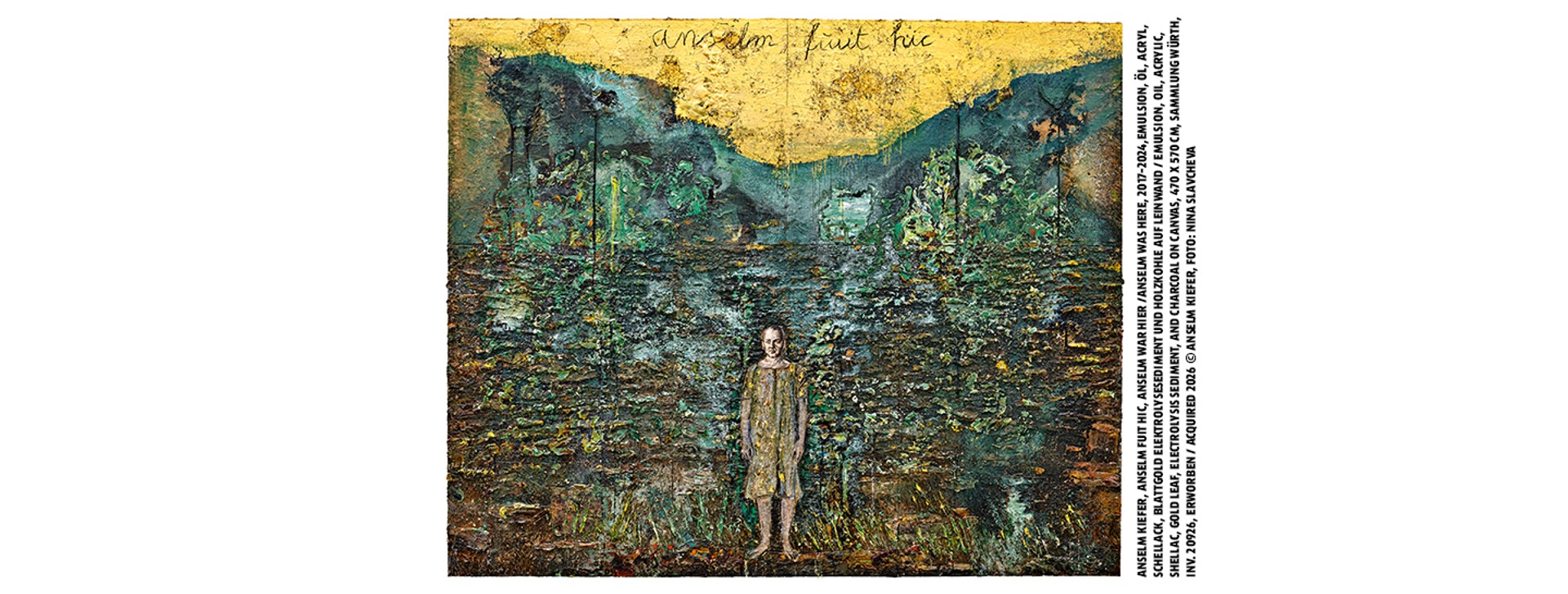
Anselm Kiefer, Anselm fuit hic, Anselm war hier /Anselm was here, 2017–2024,Emulsion, Öl, Acryl, Schellack, Blattgold Elektrolysesediment und Holzkohle auf Leinwand / Emulsion, oil, acrylic, shellac, gold leaf, electrolysis sediment, and charcoal on canvas, 470 x 570 cm, Sammlung Würth, Inv. 20926, erworben / acquired 2026 © Anselm Kiefer, Foto: Nina Slavcheva
AnselmKiefer_1000x667.jpg "Anselm Kiefer, Lorelei, 2005, Öl, Emulsion, Acryl, Blei, Gips, Vogelkäfig und Lack auf Leinwand, Sammlung Würth Inv. 18368, © Anselm Kiefer, Foto: Archiv Galerie Thaddaeus Ropac, Salzburg")
Anselm Kiefer, Lorelei, 2005, Öl, Emulsion, Acryl, Blei, Gips, Vogelkäfig und Lack auf Leinwand, Sammlung Würth Inv. 18368, © Anselm Kiefer, Foto: Archiv Galerie Thaddaeus Ropac, Salzburg

Anselm Kiefer, Laokoon, 2006, Blei und Fotografien/ Lead and photographs, 160 x100 x 120 cm,Sammlung Würth, Inv. 16981, erworben/acquired 2016 © Anselm Kiefer, Foto: Charles Duprat

Anselm Kiefer, Mme de Staël: de l’Allemagne / Mme de Staël: Über Deutschland / Mme de Staël: Germany, 2015, Acryl, Emulsion, Öl, Schellack, Kohle und Collage auf Fotografie auf Leinwand / Acrylic, emulsion, oil, shellac, charcoal, and collage on photograph on canvas, 380 x 330 cm, Sammlung Würth, Inv. 17394, erworben / acquired 2018 © Anselm Kiefer, Foto: Galerie Thaddaeus Ropac, Salzburg

AnselmKiefer, Bilderstreit / Iconoclastic Controversy, 1978, Öl und Emulsion auf Leinwand / Oil and emulsion on canvas, 185 x 331 cm, Sammlung Würth, Inv. 4028, erworben / acquired 1997 © Anselm Kiefer, Foto: Volker Naumann, Schönaich
Anselm Kiefer, Anselm fuit hic, Anselm war hier /Anselm was here, 2017–2024,Emulsion, Öl, Acryl, Schellack, Blattgold Elektrolysesediment und Holzkohle auf Leinwand / Emulsion, oil, acrylic, shellac, gold leaf, electrolysis sediment, and charcoal on canvas, 470 x 570 cm, Sammlung Würth, Inv. 20926, erworben / acquired 2026 © Anselm Kiefer, Foto: Nina Slavcheva
Anselm Kiefer, Lorelei, 2005, Öl, Emulsion, Acryl, Blei, Gips, Vogelkäfig und Lack auf Leinwand, Sammlung Würth Inv. 18368, © Anselm Kiefer, Foto: Archiv Galerie Thaddaeus Ropac, Salzburg
Anselm Kiefer, Laokoon, 2006, Blei und Fotografien/ Lead and photographs, 160 x100 x 120 cm,Sammlung Würth, Inv. 16981, erworben/acquired 2016 © Anselm Kiefer, Foto: Charles Duprat
Anselm Kiefer, Mme de Staël: de l’Allemagne / Mme de Staël: Über Deutschland / Mme de Staël: Germany, 2015, Acryl, Emulsion, Öl, Schellack, Kohle und Collage auf Fotografie auf Leinwand / Acrylic, emulsion, oil, shellac, charcoal, and collage on photograph on canvas, 380 x 330 cm, Sammlung Würth, Inv. 17394, erworben / acquired 2018 © Anselm Kiefer, Foto: Galerie Thaddaeus Ropac, Salzburg
AnselmKiefer, Bilderstreit / Iconoclastic Controversy, 1978, Öl und Emulsion auf Leinwand / Oil and emulsion on canvas, 185 x 331 cm, Sammlung Würth, Inv. 4028, erworben / acquired 1997 © Anselm Kiefer, Foto: Volker Naumann, Schönaich
A catalogue for this exhibition will be published by Swiridoff. The catalog can be purchased in our art shops or online. You can find additional details on the Swiridoff website.


 read more
 read less


